|
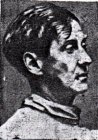
Born in Hamilton, on 16 April 1892, at 23 High Patrick Street, he was the only son of
architectural carver Mathew Dawson (1849-1917), and his wife, Ann Cozen Davidson. At the time of
his birth his father was in partnership with the Glasgow based architectural sculptor, James
Milne Sherriff (1861-1904)). After serving his apprenticeship with his father, he attended
sculpture classes at Glasgow School of Art, winning Haldane Trust awards between 1911-13.
After his studies were interrupted by the outbreak of World War I, in which he served in the
Highland Light Infantry, he returned to the school in 1920, to succeed
William Vickers
as teacher
of stone carving, 1920-38, and became Head of Modelling and Sculpture, 1929, after a brief spell
as a teacher of bronze casting at the Santa Barbara School of the Arts in San Diego, USA, c. 1926.
Amongst his pupils in San Diego were the sculptors Donald Ord (1902-66) and Mabel Karl
(1901-90), to whom he taught the cire-perdu (lost wax) process.
In Glasgow, he worked for the architectural sculptors,
James Young & Son
, which dominated the
production of sculpture in Glasgow at the time, having succeeded J & G Mossman
as the city's most prolific firm of architectural sculptors. Dawson later became a partner in
Young's firm, as Dawson & Young
It was during this time that he became associated with Jack Mortimer, Andrew Willlison and
Edward Graham in Young's workshop, the three of them being his most talented apprentices in the
early 1920s. They later formed the partnership, Mortimer Willison & Graham, which dominated the
production of building related sculpture after World War II, until the 1960s, when architectural
sculpture fell out of fashion. All three of his former pupils later acknowledged the debt that
they owed to Dawson for the quality of their early training, which they described as being
medieval in its intensity and tradition.
Specialising in ecclesiastical sculpture, Dawson worked on several early churches by Jack Coia,
and executed the stone and wood carvings at
J J Burnet
's War Memorial Chapel, Glasgow University
(1923-7), and at the Ross Memorial Church, West Regent Street, for which he also executed
exterior and interior sculpture (1927). A major work for Coia at this time was the colossal figure
of St Patrick on the front of St Patrick's RC Church, Greenock (1934). His other noted
ecclesiastical sculpture for Coia includes the figurative work on St Anne's RC Church and Presbetery,
Whitevale Street (1931), and St Columba's RC Church, Hopehill Street (1938), both in Glasgow.
He also produced sculpture for several commercial buildings in the city, the most important
of which was the North British & Mercantile Building (now Sun Alliance), 200 St.
Vincent Street (1927), the last major building designed by Sir JJ Burnet in Glasgow.
Dawson worked on the project with Andrew Willison as the carver of his models, and Jack Mortimer
as his assistant. The sculpture scheme envisioned by the architect, however, was left incomplete,
with only Dawson's relief of St Andrew and the doorway capitals finished before cost
cutting halted the rest of the carving.
Mortimer later completed the building's statuary with allegorical figures representing a
Seafarer and the Seafarers Wife, which he modelled as portraits of Dawson and his
wife,Isabell, c. 1952.
Dawson also produced the Industry and Shipbuilding figures
on the Mercat Building, Glasgow Cross (1928-9), for A G Henderson, of John Keppie & Henderson,
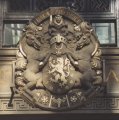
the reliefs and heraldry on the Scottish Legal Life Building, 81-107 Bothwell Street (1927-31);
and the sculpture on
J J Burnet
's Tennent Memorial Building, 38 Church Street (1933-5).
His public work is represented by the heraldic Unicorn which surmounts
the Mercat Cross at Glasgow Cross, which he carved from a model by Margaret Findlay (1930).
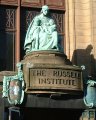
He often used his family as models for his architectural work. His wife,
Isa, and sons Alistair and (baby) Hamish, together with a young female relative,
for instance, became the Young Motherhood group over the entrance to the Russell
Institute, Paisley (1927-9).
Dawson's family life was happy and fondly remembered by his sons in later years. He married
his wife, Isabell Wharrie Nelson, on 3 July 1920, when he lived at 69 Minard Street with his
father. The family later lived at 56 Kelvingrove Street.
Comensurate with his career as an architectural sculptor, he exhibited at RGIFA
, 1914-38, showing
genre pieces and portrait busts, including Jack Coia (1933) and J.M. Groundwater
(1931), and was a member of the Glasgow Art Club, executing their War Memorial in 1922.
His final work, a colossal plaster statue of St. Andrew as a Young Man,
was commissioned for the Scottish Pavilion at the Empire Exhibition,
Bellahouston (1938), and became his memorial for the duration of the
exhibition after his sudden death, on 15 April 1938. He died at a friend's house at 81
Nithsdale Drive, and is buried in an unmarked grave in the Necropolis.
Elected ARSA
, 1936, his work is represented in private and public
collections, including GMAG
.
Sources:
- GH
[Obit], 18 April, 1938;
- Dawson, H. in Avenue no. 19
Useful links to other sites:
|