 |
|
| Newsletter No.4 | 29 April, 2002 |
|
Welcome to our April Newsletter:
|
|
This month we have been doing a lot of work on Walter Macfarlane & Co, whose Saracen Foundry produced some really beautiful castings. Nowadays examples can found in many different countries around the world.
There are some new galleries on our site of their work in Glasgow, which you shouldn't miss. | We have now added a new biography of Glasgow's greatest architect, Alexander 'Greek' Thomson. We haven't yet made up a gallery for 'Greek' Thomson, but watch this space!
Thanks again for visiting us and do send us an email if you would like to comment on our website or if you have anything to add to our research. And please don't forget to let all your friends know. See you on the website! Tim Gardner
| top |
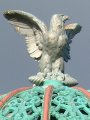 Macfarlane's is also the subject of this month's Inside Story and their biography page has been completely rewritten.
 |
New photo galleries during April:
|
 Bailie James Martin Memorial Fountain (1893-4).
This canopied fountain with a Moorish character is typical of Macfarlane's fountains to be found throughout the Commonwealth and in many other places around the world Location: Glasgow Green, near the People's Palace, Glasgow
| top |
 Saracen Fountain, Alexandra Park (1901, relocated 1914).
This beautiful fountain was Macfarlane's principal exhibit at the 1901 International Exhibition in Kelvingrove Park before being relocated to Alexandra Park in 1914 Manufacturer: Walter Macfarlane & Co (fl. 1849-1965)
| top |
 Baldowie Street Canopied Fountain (re-erected 1987).
This fountain was re-erected in Baldowie Street, close to the site of the old Saracen Foundry, in 1987 by Heritage Engineering, who now reproduce some of Macfarlane's designs. Manufacturer: Walter Macfarlane & Co (fl. 1849-1965) | top |
 Saracen Foundry Miscellany.
This gallery takes a look at five different works around Glasgow for Macfarlane's Saracen Foundry. Manufacturer: Walter Macfarlane & Co (fl. 1849-1965) | top |
 Victoria Park Golden Jubilee Gates.
Gifted by the 'Ladies of Partick' in 1887.
Manufacturer: Walter Macfarlane & Co (fl. 1849-1965) | top |
|
New biographies during April:
|
| Walter Macfarlane & Co (fl. 1849-1965). Also known as the Saracen Foundry, Macfarlane's was the most important manufacturer of ornamental ironwork in Scotland. They specialised in the production of drinking fountains, bandstands, lamp standards, pre-fabricated buildings and architectural features. This biography also gives a lists of their principal works to be found elsewhere in the world. | top |
| Alexander 'Greek' Thomson (1817-75). Alexander Thomson is the greatest of the Glasgow Victorian architects. Many of his buildings are now demolished, but see, among others, the St Vincent Street UP Church and his villa, Holmwood House in Cathcart, now owned by the National Trust for Scotland. | top |
| William B Whitie (d. 1946). This is the biography of the architect of Springburn Public Halls that was featured in February's Newsletter. However, his most prestigous commission was the Mitchell Library with its grand dome, now one of the best-loved landmarks of the city. | top |
| Peter Nicholson (1765-1844). Grandfather-in-law of Alexander 'Greek' Thomson , he was more widely known as an architectural historian and theorist than as an architect. | top |
|
Glasgow News:
|
|
Good news for fans of Alexander 'Greek' Thomson. Since his tombstone disappeared in the 1950s, he has been lying in an unmarked grave in the Southern Necropolis. It is now going to be replaced, hopefully this summer, by a smart new one in rare black granite, designed by architects Ed Taylor and Graeme Andrew. (Source: Evening Times, 09 April, 2002) Andy Scott has been commissioned to create a memorial to Rangers' legendary hero Jim Baxter, who died on April 14, 2001, after a three-month battle against cancer. The memorial will be in the form of a one-and-a-half times life-size statue, to be sited in Baxter's home village of Hill O'Beath. Andy Scott also created the Ibrox Disaster Memorial. The Merchant City Regeneration Project is now being charted in a new book and exhibition by photographer and artist Louise Crawford and architect Ian Alexander. The area is envisaged as a vibrant new 'arts quarter'. Glasgow Cross and the Trongate could become art spaces and be used for exhibitions, with the Railway bridges being lit up. There could also be a fountain in Wilson Street and a large conservatory and café for public concerts and festivals. (Visit the Merchant City website at http://www.glasgowmerchantcity.net/). As reported last month, David Mach's new exhibition at the Gallery of Modern Art is well under way. He has just finished a huge 50-ton sculpture made from four abandoned cars and 150,000 copies of The Herald. However, there are many more works in the exhibition spread over three floors, including more of his match-head sculptures, coat-hangar sculptures and a wonderful sculpture of a woman diving into a pool, seen from underwater. You can see more of David Mach's work on his own website at http://www.davidmach.com. | top |
|
Inside Story:
Walter Macfarlane & Co.'s Saracen Foundry has fascinated many people for a long time. Especially those in far-off countries who find that they too have a little bit of Glasgow at the end of their street, or in their public squares or parks; usually in the form of a canopied commemorative drinking fountain, horse trough, lampposts, railings or decorative architectural castings. Those who trace their origins inevitably find themselves following a trail which connects them with towns, villages and cities throughout the former British Empire and South America, and ultimately to Glasgow and its northern district of Possilpark, the home of Macfarlane's Saracen Foundry from 1872 until its demolition in 1967. Possilpark is as much a product of the foundry as its castings, having been developed by Macfarlane's to house their vast work-force and the service industries which sustained it. Sadly, Possilpark has suffered greatly from the loss of the foundry and other major employers in the late 20th century (e.g., A & J Main's foundry which produced railings and park benches by the millions), and the effects of the social crises that replaced them. The Saracen Foundry, however, looms large in the area's folk memory and is commemorated not only in the collection of blond sandstone tenements and the names of their streets, together with the handsome public library which was built on land gifted by the second Walter Macfarlane in 1909, but also by a splendid gable-end mural, in Saracen Street, and the canopy from one of the foundry's universally popular designs for drinking fountains near the junction of Saracen Cross and Baldowie Street. There was also once a drinking trough, lamp and clock which had stood at Saracen Cross from 1878, when it was gifted to the community by Walter Macfarlane I, but this has long since been removed.
The mural is in a very poor state and deserves to be restored. Nearby, however, the Baldowie Street fountain is now a feature in a landscaped area and is in fairly good condition. This was restored in 2000 by Glasgow based Heritage Engineering, free of charge, as a monument to the foundry after they had been commissioned to replicate the fountain for a park in Cardiff. The colour scheme of the Baldowie Street fountain was chosen by the local community and is probably close to its original livery. Heritage Engineering specialise in restoring and reproducing Macfarlane's castings and have resurrected the old firm's name in also trading as Walter Macfarlane & Co. They are based at 22-24 Carmyle Avenue, Glasgow, G32 8AJ. In concentrating on Macfarlane's this month, we hope to have gathered together some of the strands which link Glasgow with the world, and in identifying many of the fountains and castings which we have in common, we hope to share these with you by illustrating their Glasgow originals and by providing links to websites which feature other examples. We are also keen to hear from anyone who knows of other Macfarlane's castings throughout the world (and any other Glasgow foundry), so please get in touch. It would be particularly interesting to see if there are any European examples of Macfarlane's castings. Author: Gary Nisbet
| top |
 The mural, of 1990, by an unknown artist, illustrates the foundry's huge gates, glass dome and crested chimneys, examples of the firm's castings, including a bandstand, a foundry-man and the Saracen after whom the foundry was named, and who links the firm to Glasgow's historic Gallowgate and the old Saracen Head Inn. It was, of course, in Saracen Lane, adjacent to the Inn, where Walter Macfarlane senior established the first Saracen Foundry in 1849.
|
Book Choice:
|
|
Glasgow
Published by Penguin Books, London, Buy this book from...
| top |
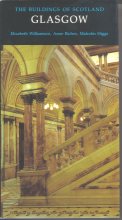 The most comprehensive survey of Glasgow's architecture yet published,
it is arranged in the gazetteer form established by Pevsner's Buildings
Of England series. Documenting the development of the city's architecture
from pre-Roman times to 1990, it is a walk though Glasgow's history and up
and down virtually every street in the city. In short, it is the Glasgow
historian's Bible. Meticulously researched and astonishing in its wealth
and variety of detail, Glasgow is a scholarly but highly accessible
and enjoyable resource for the casual reader and the serious researcher.
Illustrated with 123 b/w photographs of the city's most important buildings
and monuments, it is essential reading for anyone interested in the city
and the architects and craftsmen and women who enriched it.
The most comprehensive survey of Glasgow's architecture yet published,
it is arranged in the gazetteer form established by Pevsner's Buildings
Of England series. Documenting the development of the city's architecture
from pre-Roman times to 1990, it is a walk though Glasgow's history and up
and down virtually every street in the city. In short, it is the Glasgow
historian's Bible. Meticulously researched and astonishing in its wealth
and variety of detail, Glasgow is a scholarly but highly accessible
and enjoyable resource for the casual reader and the serious researcher.
Illustrated with 123 b/w photographs of the city's most important buildings
and monuments, it is essential reading for anyone interested in the city
and the architects and craftsmen and women who enriched it.


|
Don't forget to use the [F11] key:
|
|
When browsing our website you may find that you need more room to view the photo-galleries. That is where the [F11] key comes in. Press this key and you will get a full screen with just a narrow tool-bar at the top. If you liked that then right-click on the narrow tool-bar and select Auto-Hide. This will hide the tool-bar itself whenever you are not using it. Just slide the mouse-pointer towards the top of the screen and it will appear again. Press the [F11] key again to return to normal.
Unfortunately, this only works for MS Internet Explorer browsers. | top |
|
Recommend us to a friend:
|
| Please forward this newsletter on to any of your friends or colleagues who you feel may be even remotely interested in Glasgow or Sculpture. Even if they aren't now, I'm sure they soon will be. | top |
|
Unsubscribe or change email address.
Also for friends to confirm their subscription:
|
|
If you are one of the lucky ones that have been sent a complimentary copy of this Newsletter from one of your friends, please send a blank email to confirm and your subscription will be continued (just click on the underlined email address). No need to type anything. We will get your email address automatically.
If you wish to change the email address we send your Newsletter to, then please send an email to changeaddress, not forgetting to put your new address in the message field (just click on the underlined email address). If you would like to cancel your subscription completely, please send a blank email to cancel (just click on the underlined email address). In any case please be assured that we never pass on email addresses to any third party for any reason whatsoever. If you cancel an email address with us, then that address will be permanently removed from all our files. | top |
|
Contact us.
|
|
Email for general enquiries and information.
Email Tim Gardner, the editor and webmaster. Email Gary Nisbet, the historian. | top |
| Copyright 2002 scot-it.com | top |